Coming out doesn't solve all your problems.
You're thinking, "duh, Chris!" But it's taken me 18 months and some recent rocky times in my relationship to figure that out.
It's hard to shake a lifetime of fighting your nature and building closets for yourself. I'm not like some of the (once) married gay men I've known in that I wasn't out to my wife during our marriage. I learned how to hide from her--and myself--pretty effectively. Once out, I thought the compulsion to hide would naturally dissipate. And it did for awhile.
But it turns out I have some issues--and closets--that might not have anything to do with being gay. Imagine that! Some of the things that I thought would resolve themselves because I am now openly gay actually got worse before I was able to recognize them as issues that need to be addressed. The good news is that I am now working on my issues and I'm learning a lot about myself and addressing things that I have been actively avoiding. And I'm blessed to have a man in my life who is standing with me through this because he loves all of me--the good, the bad and the ugly.
Last summer, our marriage at an end, I told KK that I didn't need anyone. I was trying to tell her that I was emotionally independent and capable of taking care of myself and moving on. She told me that she thought what I said was sad. It's only very recently that I have been able to see that she was right. We all need to be loved, and we all need to give love. It's part of what makes us human. I have always battled the thought that I have to be "good" in order to be loved. I'm not sure where that comes from. It might be the dynamics in my family; it might be the way I internalized Mormon and Christian teaching and theology; it might be my psychology; it might be all of the above and more. KK has shown me that unconditional love over the years we have known each other, and has continued to show it even after marriage. Jed now shows it to me every day. I'm finally ready to not only admit that I need it, but to accept it and offer it to myself as well. I hope this will make me a better person, partner, friend, father, brother, son, confidant, and former spouse. I aspire to be loving and honest in all of these roles in my life.
I'm taking a break from blogging and interneting for awhile. HURRICANE has been dying a slow death anyway, so this break might finally be the end of it. Or maybe not. But I'm going to go take care of myself for awhile, re-commit to my wonderful partner (even though we don't call each other that!), prepare for a wonderful summer with my children, and do what I can to nurture, repair and improve the relationships that have brought so many good things into my life.
Monday, May 07, 2007
Monday, April 09, 2007
Out of the mouths of babes...
Driving through the Lincoln Tunnel to New Jersey from Manhattan on a bus, my four-year-old daughter, who had been gazing out the window, turned to me and, wide-eyed, exclaimed: "Daddy, I think this bus is going as fast as the government will allow!"
Friday, April 06, 2007
Benediction, Part II: Covering
In his important new book Covering, Yale Law School professor Kenji Yoshino uses the prism of his experience as a gay Asian American and his training as a legal scholar to examine the subtle ways that women and ethnic, religuous and sexual minorities are often forced to compromise their civil rights, their identity and their dignity in order to blend into the mainstream.
At first glance, covering appears less insidious than other societal demands made of minorities. In the past many have been forced to try to convert. Others respond to such demands by quietly passing. Covering is more subtle, as it often involves simply trying to "tone down" undesirable or stigmatized identities.
In my own evolution as a gay man, I have been through each of the stages Yoshino describes in his book. I sought to convert myself away from homosexuality, going so far as to convert to a religion that held the promise that I didn't have to be gay if I didn't want to be. When I failed in my efforts to convert, I continued to pass. I was married, fathered two children, and actively engaged in activities and a lifestyle that was easily identifiable as heterosexual. When passing became too much of a burden, I was still content to cover. I came out to my wife and a small circle of family members, but I chose not to engage in any way in a lifestyle that was identifiable as gay.
My covering stage was the shortest in its duration. Once I was finally able to accept that I was gay and that it wasn't wrong for me to be gay, I quickly decided that I had no desire to cover my identity. In fact, for a period I was uncomfortable letting stand the assumption that I was straight. I came out in ways that were probably unnecessary. But I would rather have people know I was gay unnecessarily than let them assume that I was straight.
The demand that I cover, however, remains a constant, particularly in circles where acceptance of homosexuality is tenuous. A few months ago I was involved in a discussion on an LDS blog called By Common Consent. It was a discussion of Carol Lynn Pearson's No More Goodbyes, and when I wondered aloud (as it were) what I should do to build bridges of reconciliation with my former faith community, one of the discussion participants told me rather pointedly that I should "get over" myself and recognize that my sexuality was just a "small part" of who I am. Why, he wondered, couldn't I ever talk about anything else on LDS blogs besides homosexuality?
The unfairness of his charge was apparent to me (and others), as I know that my interests are wide ranging. But more than being personally unfair, he was doing what if often demanded of gay people--asking that I cover my sexuality. It's okay for me to be gay, but, please, stop talking about it! As I have become more comfortable being out, I have seen this dynamic play out over and over again. "Straight acting" homosexual men are somehow more acceptable than obviously or more flamboyantly gay men. We see the demand to cover in a very pointed way in the LDS Church and other conservative religious traditions. LDS authorities have taken a page from the Catholic playbook in declaring that to feel homosexual attraction is not sinful, but acting on it of course is. In other words, it's okay to be gay as long one doesn't ever actually do any of the things that define one as gay--namely, have an intimate relationship with someone of the same sex. The covering demand of homosexuals in Mormon culture is further played out when homosexual Mormons themselves respond to the covering demand by downplaying the significance of their orientation, dismissing it as an annoying fact that in no way defines them or how they will live their lives. Just because they are gay doesn't mean that can't live their lives just as any other Mormon might, hoping for marriage and family or quietly soldiering on in celibacy, depending on the circumstances.
This is not unique to the LDS experience, of course. Such demands that gays "keep it to themselves" are commonplace in other religious tradtions, in the workplace, and on the athletic field (see John Amaechi). Quiet, apparently asexual homosexuals are far less threatening to the status quo and the moral order than those who live openly. And there are reverse covering demands imposed by the gay community as well--we passionately ask all homosexuals to come out, to live life as openly and defiantly as they can, and to reject any suggestion that to do so is in anyway problematic. Alas, life is not so simple.
As much as I want to be finished covering, I still do it. I hate it, but it happens. Maybe I don't mention Jed in certain situations when I easily could, or I withdraw from conversations about family and marriage because I don't want to have to explain my own personal transformation and circumstances. These things don't happen often anymore, but they happen. Sometimes I'm responding to an external demand that I cover, but other times I'm still fighting my own internal battles. But I firmly believe that recognizing the demand to cover is an important final step in coming out.
At first glance, covering appears less insidious than other societal demands made of minorities. In the past many have been forced to try to convert. Others respond to such demands by quietly passing. Covering is more subtle, as it often involves simply trying to "tone down" undesirable or stigmatized identities.
In my own evolution as a gay man, I have been through each of the stages Yoshino describes in his book. I sought to convert myself away from homosexuality, going so far as to convert to a religion that held the promise that I didn't have to be gay if I didn't want to be. When I failed in my efforts to convert, I continued to pass. I was married, fathered two children, and actively engaged in activities and a lifestyle that was easily identifiable as heterosexual. When passing became too much of a burden, I was still content to cover. I came out to my wife and a small circle of family members, but I chose not to engage in any way in a lifestyle that was identifiable as gay.
My covering stage was the shortest in its duration. Once I was finally able to accept that I was gay and that it wasn't wrong for me to be gay, I quickly decided that I had no desire to cover my identity. In fact, for a period I was uncomfortable letting stand the assumption that I was straight. I came out in ways that were probably unnecessary. But I would rather have people know I was gay unnecessarily than let them assume that I was straight.
The demand that I cover, however, remains a constant, particularly in circles where acceptance of homosexuality is tenuous. A few months ago I was involved in a discussion on an LDS blog called By Common Consent. It was a discussion of Carol Lynn Pearson's No More Goodbyes, and when I wondered aloud (as it were) what I should do to build bridges of reconciliation with my former faith community, one of the discussion participants told me rather pointedly that I should "get over" myself and recognize that my sexuality was just a "small part" of who I am. Why, he wondered, couldn't I ever talk about anything else on LDS blogs besides homosexuality?
The unfairness of his charge was apparent to me (and others), as I know that my interests are wide ranging. But more than being personally unfair, he was doing what if often demanded of gay people--asking that I cover my sexuality. It's okay for me to be gay, but, please, stop talking about it! As I have become more comfortable being out, I have seen this dynamic play out over and over again. "Straight acting" homosexual men are somehow more acceptable than obviously or more flamboyantly gay men. We see the demand to cover in a very pointed way in the LDS Church and other conservative religious traditions. LDS authorities have taken a page from the Catholic playbook in declaring that to feel homosexual attraction is not sinful, but acting on it of course is. In other words, it's okay to be gay as long one doesn't ever actually do any of the things that define one as gay--namely, have an intimate relationship with someone of the same sex. The covering demand of homosexuals in Mormon culture is further played out when homosexual Mormons themselves respond to the covering demand by downplaying the significance of their orientation, dismissing it as an annoying fact that in no way defines them or how they will live their lives. Just because they are gay doesn't mean that can't live their lives just as any other Mormon might, hoping for marriage and family or quietly soldiering on in celibacy, depending on the circumstances.
This is not unique to the LDS experience, of course. Such demands that gays "keep it to themselves" are commonplace in other religious tradtions, in the workplace, and on the athletic field (see John Amaechi). Quiet, apparently asexual homosexuals are far less threatening to the status quo and the moral order than those who live openly. And there are reverse covering demands imposed by the gay community as well--we passionately ask all homosexuals to come out, to live life as openly and defiantly as they can, and to reject any suggestion that to do so is in anyway problematic. Alas, life is not so simple.
As much as I want to be finished covering, I still do it. I hate it, but it happens. Maybe I don't mention Jed in certain situations when I easily could, or I withdraw from conversations about family and marriage because I don't want to have to explain my own personal transformation and circumstances. These things don't happen often anymore, but they happen. Sometimes I'm responding to an external demand that I cover, but other times I'm still fighting my own internal battles. But I firmly believe that recognizing the demand to cover is an important final step in coming out.
Friday, March 02, 2007
Benediction, Part I: Integration and Reconciliation
HURRICANE is winding down. This blog was an invaluable part of my coming out process. But its moment is passing as I find myself on ever more solid ground as a out gay man. It occupies a space in the blogosphere that corresponds with a space where I no longer live: gay, married and Mormon.
But before I go, I am going to write a series of posts on themes that are important to me at this stage of life: integrating and reconciling the past, covering, and belonging.
I have written on this blog about integration in the way that many gay people talk about it after coming out. Bringing my identity and my sexuality into alignment lifted a dark fog from my mind. Integration is an essential part of the coming out process. But that's not the integration I have in mind now. Over the past few weeks I have intensified a different type of integration process. This one involves reconciling my current self to my past self. Part of that has been forgiving, myself and others, and essential to forgiving is recognizing and celebrating the good things about my old life. With my immediate family, that is easy. My love for my children knows no bounds. My friendship with KK remains strong and an important part of my life, and I value the good things that came as a result of our marriage. Other relationships, such as those with parents and old friends, are also worth holding on to and strenthening, and I am striving to do that. I have struggled more with forgiving other presences from my past. In particular, I have felt anger and bitterness toward the LDS Church. But lately I've found myself forgiving there as well, and remembering the good things that came from my Mormon experience.
HURRICANE is not my first blog. I had another one that I called Outer Boroughs in a nod to my place of residence at the time I was writing on it: Brooklyn. I used it to write about politics and culture and religion and the Mormon experience. After my faith fell apart, I took the blog down. But a few months ago I went back and read some of the posts. I still like many of them. They don't reflect my current reality or my current faith for the most part, but I think they reflect the kind of Mormon I was and they honor the good that Mormonism brought into my life.
So in this, the first part of my HURRICANE benediction, I share a handful of my blog posts from Outer Boroughs that I think capture who I was then, and who I hope in many respects I still am now:
Confession
Civil Breakdown
Convert Soul
Is God a Muskie?
But before I go, I am going to write a series of posts on themes that are important to me at this stage of life: integrating and reconciling the past, covering, and belonging.
I have written on this blog about integration in the way that many gay people talk about it after coming out. Bringing my identity and my sexuality into alignment lifted a dark fog from my mind. Integration is an essential part of the coming out process. But that's not the integration I have in mind now. Over the past few weeks I have intensified a different type of integration process. This one involves reconciling my current self to my past self. Part of that has been forgiving, myself and others, and essential to forgiving is recognizing and celebrating the good things about my old life. With my immediate family, that is easy. My love for my children knows no bounds. My friendship with KK remains strong and an important part of my life, and I value the good things that came as a result of our marriage. Other relationships, such as those with parents and old friends, are also worth holding on to and strenthening, and I am striving to do that. I have struggled more with forgiving other presences from my past. In particular, I have felt anger and bitterness toward the LDS Church. But lately I've found myself forgiving there as well, and remembering the good things that came from my Mormon experience.
HURRICANE is not my first blog. I had another one that I called Outer Boroughs in a nod to my place of residence at the time I was writing on it: Brooklyn. I used it to write about politics and culture and religion and the Mormon experience. After my faith fell apart, I took the blog down. But a few months ago I went back and read some of the posts. I still like many of them. They don't reflect my current reality or my current faith for the most part, but I think they reflect the kind of Mormon I was and they honor the good that Mormonism brought into my life.
So in this, the first part of my HURRICANE benediction, I share a handful of my blog posts from Outer Boroughs that I think capture who I was then, and who I hope in many respects I still am now:
Confession
Civil Breakdown
Convert Soul
Is God a Muskie?
Wednesday, February 14, 2007
To my Valentines...

Happy Valentine's Day to my daughters. I love you girlies like crazy. And sometimes I miss you so much my heart hurts.

Monday, February 12, 2007
New York Times on Change Therapy
A Mormon man and a BYU-trained therapist are among those featured in "Reining in Desires Proves Complex, at Best," a story on the front page of the Metro section of today's New York Times.
(Free registration with the New York Times is required to read the article.)
(Free registration with the New York Times is required to read the article.)
Thursday, February 08, 2007
For the Bible Tells Me So
This film is about faith, homosexuality, family, and the difference between what the Bible says and what it means. It was screened at Sundance this year, and though I haven't seen it, I did listen to this Radio West interview with the director. Have a listen.
Thursday, January 25, 2007
Wednesday, January 24, 2007
New Perspectives
Last Saturday night, J and I were out with a couple of his friends, one of whom is a faithful and believing Catholic. Talk turned to religion and J, who was raised Mormon, asked her, "So, you believe that the Catholic Church is the one true church?" She looked at him as if he had asked her the question in Lithuanian. Then she looked as though the question had never crossed her mind.
Having spent the last year attending a church where no one is invested in whether or not it's the one and only true one, the question seemed odd to me as well. But I also understood that it made perfect sense, as I have sat through many testimony meetings in my life (not to mention Sunday School lessons, priesthood lessons, and sacrament meetings). Belief that the LDS Church is the only true church is integral for Mormons, and for many of us who were Mormon it is hard not to think about religion in other terms. So it is often surprising to realize that many people of faith and spirituality do not think in those terms at all. For our Catholic friend, her faith was not in a church that she considers to be the only true one or the guardian of ultimate truth. Rather it is a vehicle for cultivating spirituality and compassion.
I know many Mormons who are like this as well, to be sure. Indeed, I think the Mormons with whom I always have always felt most comfortable, both when I was a Mormon and since leaving the church, were those who don't seem particularly invested in the idea of a single true church at all. They practice their faith as though the Mormon Church is a right way rather than the only way. But J wasn't like that and even now in the post-Mormon phase of his life he couldn't really understand why anyone would be committed to a church they didn't think was God's True Church. For him it had always been the Mormon Church or no church. Always, that is, until our friend gave him that puzzled look and talked about her faith with us.
The next morning, J and I went with a group from my church in New Jersey to Sunday services at Marble Collegiate Church in Manhattan. J had been to services with me in New Jersey before (reluctantly, though he has since admitted that he liked it more than he wanted to), but he seemed to approach this experience with a new found openness. As he let go of the idea that there is or should be a single way or that churches themselves should proclaim such a thing, he seemed to discover that perhaps there were ways for him to connect to his spirituality that he thought he had rejected--that is, sitting at church on Sunday morning. I think it was a remarkable experience for him.
It reminded me of my first visit to Union Congregational, where I felt a sense of divine love and acceptance and connection that had been sorely lacking in my life to that point. I don't want to toss the baby out with the bath water as I move forward with my life. I'm still much more of a Christian-y agnostic than any kind of true believer, but that does not preclude me from embracing the support and meaning I find in church community and the sprituality I find in the beauty of Christian worship. I also am still deeply moved by the compassion and concern for the downtrodden that I find in the teachings of Jesus. The United Church of Christ, to which my congregation belongs, proclaims that God accepts us all where we are. I can't believe in things I don't believe in--and I am grateful to have found a reason and a place to to worship God in a setting where I'm not expected to.
Having spent the last year attending a church where no one is invested in whether or not it's the one and only true one, the question seemed odd to me as well. But I also understood that it made perfect sense, as I have sat through many testimony meetings in my life (not to mention Sunday School lessons, priesthood lessons, and sacrament meetings). Belief that the LDS Church is the only true church is integral for Mormons, and for many of us who were Mormon it is hard not to think about religion in other terms. So it is often surprising to realize that many people of faith and spirituality do not think in those terms at all. For our Catholic friend, her faith was not in a church that she considers to be the only true one or the guardian of ultimate truth. Rather it is a vehicle for cultivating spirituality and compassion.
I know many Mormons who are like this as well, to be sure. Indeed, I think the Mormons with whom I always have always felt most comfortable, both when I was a Mormon and since leaving the church, were those who don't seem particularly invested in the idea of a single true church at all. They practice their faith as though the Mormon Church is a right way rather than the only way. But J wasn't like that and even now in the post-Mormon phase of his life he couldn't really understand why anyone would be committed to a church they didn't think was God's True Church. For him it had always been the Mormon Church or no church. Always, that is, until our friend gave him that puzzled look and talked about her faith with us.
The next morning, J and I went with a group from my church in New Jersey to Sunday services at Marble Collegiate Church in Manhattan. J had been to services with me in New Jersey before (reluctantly, though he has since admitted that he liked it more than he wanted to), but he seemed to approach this experience with a new found openness. As he let go of the idea that there is or should be a single way or that churches themselves should proclaim such a thing, he seemed to discover that perhaps there were ways for him to connect to his spirituality that he thought he had rejected--that is, sitting at church on Sunday morning. I think it was a remarkable experience for him.
It reminded me of my first visit to Union Congregational, where I felt a sense of divine love and acceptance and connection that had been sorely lacking in my life to that point. I don't want to toss the baby out with the bath water as I move forward with my life. I'm still much more of a Christian-y agnostic than any kind of true believer, but that does not preclude me from embracing the support and meaning I find in church community and the sprituality I find in the beauty of Christian worship. I also am still deeply moved by the compassion and concern for the downtrodden that I find in the teachings of Jesus. The United Church of Christ, to which my congregation belongs, proclaims that God accepts us all where we are. I can't believe in things I don't believe in--and I am grateful to have found a reason and a place to to worship God in a setting where I'm not expected to.
Friday, January 12, 2007
Conscience
What is conscience?
As I understand it, conscience is the inner sense of what is right or wrong in one's conduct or motives, which also impels one toward right. I remember telling investigators on my mission that conscience was the influence of the Holy Spirit, guiding them to do what is right. I know that's not doctrinal, but it was a useful way to explain to people how they could be guided to do the right and moral thing in their lives. And it was effective in showing people how something within them could enable them to align their lives with God's will.
This has been on my mind a lot of late. Over on L's blog, Scot and L are having a discussion about it that was sparked by L's post on Idolatry. Scot has also written recently about his struggle with conscience as a gay teen at Boys State. And in another online forum where I am a regular participant, there was a discussion that began with the question of how we would respond if forced to choose between our religion or our country. One of the participants said that he'd choose neither. He would instead choose his conscience.
Scot's story in particular reminded me of when I was new to New York City and had just been called to serve on the high council of our LDS stake in Brooklyn. I've written this story there, but I'd like to revisit it here as well.
The stake presidency knew I worked in public relations, so they gave me the stake public affairs portfolio as well as a ward assignment not long after I was called. This was in 1999, and there was talk in conservative circles here in New York of organizing a campaign against same-sex marriage, which was assumed to be on its way. The church had become active in this, and there was an unofficial coordinator who worked with all of the stake public affairs representatives in the area. I was handed a thick file documenting what action had been taken and what action was under consideration. I was encouraged to draft e-mails and letters to members of the state legislature, and to cultivate support for action against gay marriage in the wards in my stake.
I dragged my feet on it. I did not want to do it. At the time I convinced myself that I just didn't know where I stood on these issues for gay people (since I wasn't one!) and I even voiced some of my discomfort to a member of the stake presidency in a very private, very cautious way. He encouraged me to do my best, but the implication that I should do my best in support of the church's position was clear.
A few months later, before I had a chance to do anything, I was release from the High Council and called as bishop. I was relieved that I wouldn't have to deal with the same-sex marriage politics, because I was so conflicted about it. But then, in the last two years of my tenure as bishop, same-sex marriage politics REALLY began to heat up and I started to worry about the Church asking me to do something that would deepen my inner conflict, which had begun to intensify. But they never did.
Fast forward to earlier this year. The LDS Church did, finally, ask its bishops and branch presidents to read a letter to their congregations affirming the Church's support for a constitutional amendment banning gay marriage and asked its members to write to their elected representatives in Washington to express their support for such an amendment.
I wonder what I would have done if I had been the one presiding over the ward in Brooklyn earlier this year. Would I have read that letter? I don't know. It's hard for me now to think that I would, but I suspect I would have felt duty bound. Perhaps I would have excused myself from conducting the meeting that day so that one of my counselors would have been the one to give voice to the letter. I certainly can't imagine that I would have flatly refused to do it, and never mind making my reasons for not doing it public. In an interesting twist, though, the letter was read in my old ward in Brooklyn, which my family and I left in the summer of 2005, the same Sunday that most people in the ward found out that I was gay and that KK and I were getting divorced. I guess I ended up taking a stand against the Church's political statement after all. But it was not an act of conscience. It was a convergence of events that can be seen as a public statement of sorts.
Acts of conscience require some sort of action, often in opposition to or in support of someone or something else. My conscience -- my inner sense of what is right and wrong -- has been the guiding force that has moved me away from the LDS Church, and it is my conscience that consistently tells me that it is the right thing for me. Some might look at that and, because it conflicts with their faith or their world view, conclude that I am misguided, or that in choosing conscience I am rejecting God's plan for me and following a path that is false or harmful or immoral. Ultimately I think that says more about the person making that conclusion than it does about me. (Though I live with a certain amount of discomfort knowing that some friends and family likely think this about me. We all want to be validated.)
Whatever we think of other people's choices, I think most of us would agree that choosing not to follow one's conscience often leads to feelings of regret and unhappiness. My Mormon experience taught me to listen to the still small voice. I'm grateful for that learning.
As I understand it, conscience is the inner sense of what is right or wrong in one's conduct or motives, which also impels one toward right. I remember telling investigators on my mission that conscience was the influence of the Holy Spirit, guiding them to do what is right. I know that's not doctrinal, but it was a useful way to explain to people how they could be guided to do the right and moral thing in their lives. And it was effective in showing people how something within them could enable them to align their lives with God's will.
This has been on my mind a lot of late. Over on L's blog, Scot and L are having a discussion about it that was sparked by L's post on Idolatry. Scot has also written recently about his struggle with conscience as a gay teen at Boys State. And in another online forum where I am a regular participant, there was a discussion that began with the question of how we would respond if forced to choose between our religion or our country. One of the participants said that he'd choose neither. He would instead choose his conscience.
Scot's story in particular reminded me of when I was new to New York City and had just been called to serve on the high council of our LDS stake in Brooklyn. I've written this story there, but I'd like to revisit it here as well.
The stake presidency knew I worked in public relations, so they gave me the stake public affairs portfolio as well as a ward assignment not long after I was called. This was in 1999, and there was talk in conservative circles here in New York of organizing a campaign against same-sex marriage, which was assumed to be on its way. The church had become active in this, and there was an unofficial coordinator who worked with all of the stake public affairs representatives in the area. I was handed a thick file documenting what action had been taken and what action was under consideration. I was encouraged to draft e-mails and letters to members of the state legislature, and to cultivate support for action against gay marriage in the wards in my stake.
I dragged my feet on it. I did not want to do it. At the time I convinced myself that I just didn't know where I stood on these issues for gay people (since I wasn't one!) and I even voiced some of my discomfort to a member of the stake presidency in a very private, very cautious way. He encouraged me to do my best, but the implication that I should do my best in support of the church's position was clear.
A few months later, before I had a chance to do anything, I was release from the High Council and called as bishop. I was relieved that I wouldn't have to deal with the same-sex marriage politics, because I was so conflicted about it. But then, in the last two years of my tenure as bishop, same-sex marriage politics REALLY began to heat up and I started to worry about the Church asking me to do something that would deepen my inner conflict, which had begun to intensify. But they never did.
Fast forward to earlier this year. The LDS Church did, finally, ask its bishops and branch presidents to read a letter to their congregations affirming the Church's support for a constitutional amendment banning gay marriage and asked its members to write to their elected representatives in Washington to express their support for such an amendment.
I wonder what I would have done if I had been the one presiding over the ward in Brooklyn earlier this year. Would I have read that letter? I don't know. It's hard for me now to think that I would, but I suspect I would have felt duty bound. Perhaps I would have excused myself from conducting the meeting that day so that one of my counselors would have been the one to give voice to the letter. I certainly can't imagine that I would have flatly refused to do it, and never mind making my reasons for not doing it public. In an interesting twist, though, the letter was read in my old ward in Brooklyn, which my family and I left in the summer of 2005, the same Sunday that most people in the ward found out that I was gay and that KK and I were getting divorced. I guess I ended up taking a stand against the Church's political statement after all. But it was not an act of conscience. It was a convergence of events that can be seen as a public statement of sorts.
Acts of conscience require some sort of action, often in opposition to or in support of someone or something else. My conscience -- my inner sense of what is right and wrong -- has been the guiding force that has moved me away from the LDS Church, and it is my conscience that consistently tells me that it is the right thing for me. Some might look at that and, because it conflicts with their faith or their world view, conclude that I am misguided, or that in choosing conscience I am rejecting God's plan for me and following a path that is false or harmful or immoral. Ultimately I think that says more about the person making that conclusion than it does about me. (Though I live with a certain amount of discomfort knowing that some friends and family likely think this about me. We all want to be validated.)
Whatever we think of other people's choices, I think most of us would agree that choosing not to follow one's conscience often leads to feelings of regret and unhappiness. My Mormon experience taught me to listen to the still small voice. I'm grateful for that learning.
Wednesday, January 03, 2007
Charlotte's Web
Halfway through the movie, which my girls had already seen once, E leans over to me and whispers loudly, "Dad, it's even better the second time!"
I had a very nice holiday. Hope you did, too. Happy New Year!
I had a very nice holiday. Hope you did, too. Happy New Year!
Saturday, December 23, 2006
No More Goodbyes: Circling the Wagons Around Our Gay Loved Ones
Read this book:
 I bought it a few weeks ago, but hadn't had the chance to dive into it until yesterday, when I had a long day of travel from New York to Salt Lake City. I started it on my flight from Newark to Chicago and finished it about 20 minutes before I landed in Salt Lake.
It is, in a word, remarkable. Carol Lynn Pearson is a voice of compassion and understanding for gay people and their families, particularly those from religious backgrounds. Of course, she comes to the topic from a very personal place. She married a gay man (and told the story of her marriage in the book Goodbye, I Love You), and her daughter married a gay man. She has befriended and comforted hundreds of gay people and their families since she began dealing with the "issue" of homosexuality in her life decades ago.
If you are gay, read this book. If you have a gay family member, read this book. If you have gay friends, read this book. If you want to better understand homosexuality, read this book. If you believe in love and family, read this book.
As I read the last few pages, I was overcome with emotion. I was sitting on a plane, surrounded by strangers, quietly weeping. They weren't tears of sadness. They were tears of gratitude that we have voices of compassion such as Carol Lynn Pearson's urging us on to be better than we are, to not accept what is as what must be. They were tears of gratitude that my family has circled their wagons around me, their gay loved one. And when I speak of my family, I speak of Keri and her parents and siblings, who have loved me through a crisis that led to a transformation of our family relationships. The one constant has been love. I am so grateful to be here with them for the Christmas holidays. I love them, and I know they love me. They are my family.
Read this book.
 I bought it a few weeks ago, but hadn't had the chance to dive into it until yesterday, when I had a long day of travel from New York to Salt Lake City. I started it on my flight from Newark to Chicago and finished it about 20 minutes before I landed in Salt Lake.
It is, in a word, remarkable. Carol Lynn Pearson is a voice of compassion and understanding for gay people and their families, particularly those from religious backgrounds. Of course, she comes to the topic from a very personal place. She married a gay man (and told the story of her marriage in the book Goodbye, I Love You), and her daughter married a gay man. She has befriended and comforted hundreds of gay people and their families since she began dealing with the "issue" of homosexuality in her life decades ago.
If you are gay, read this book. If you have a gay family member, read this book. If you have gay friends, read this book. If you want to better understand homosexuality, read this book. If you believe in love and family, read this book.
As I read the last few pages, I was overcome with emotion. I was sitting on a plane, surrounded by strangers, quietly weeping. They weren't tears of sadness. They were tears of gratitude that we have voices of compassion such as Carol Lynn Pearson's urging us on to be better than we are, to not accept what is as what must be. They were tears of gratitude that my family has circled their wagons around me, their gay loved one. And when I speak of my family, I speak of Keri and her parents and siblings, who have loved me through a crisis that led to a transformation of our family relationships. The one constant has been love. I am so grateful to be here with them for the Christmas holidays. I love them, and I know they love me. They are my family.
Read this book.
Thursday, December 21, 2006
Happy Birthday to KK!

I won't try to match the eloquence of her post on my birthday, but I do want to wish her the happiest of days here on the blog. Today she is a radiant 34.
In that post on my birthday, she wrote of me: The year between his 34th birthday and his 35th birthday is certainly the biggest of his life. To have accomplished all that he has in terms of facing a frightening truth, treating his family in a loving and considerate way while figuring out how to come out, deftly navigating the waters of homophobia and misplaced faith with grace and respect, and finishing the year by running TWENTY-SIX POINT TWO MILES is more than most of us accomplish in a lifetime.
KK has had a similarly momentous year between 33 and 34 that deserves some acknowledgement. She has faced the biggest crisis of her adult life with grace and forgiveness, extended (to many people unfathomable) compassion to me, begun the sometimes daunting process of trying to figure out what she wants to be when she grows up, and put herself in a place where she can be surrounded on a daily basis by the love and warmth and support of many people who love her deeply. She didn't cap her year off with a marathon, though if you asked her, I suspect she'd tell you that she feels like she has run one.
Join me in wishing her the best. Happy birthday, Keri!
In that post on my birthday, she wrote of me: The year between his 34th birthday and his 35th birthday is certainly the biggest of his life. To have accomplished all that he has in terms of facing a frightening truth, treating his family in a loving and considerate way while figuring out how to come out, deftly navigating the waters of homophobia and misplaced faith with grace and respect, and finishing the year by running TWENTY-SIX POINT TWO MILES is more than most of us accomplish in a lifetime.
KK has had a similarly momentous year between 33 and 34 that deserves some acknowledgement. She has faced the biggest crisis of her adult life with grace and forgiveness, extended (to many people unfathomable) compassion to me, begun the sometimes daunting process of trying to figure out what she wants to be when she grows up, and put herself in a place where she can be surrounded on a daily basis by the love and warmth and support of many people who love her deeply. She didn't cap her year off with a marathon, though if you asked her, I suspect she'd tell you that she feels like she has run one.
Join me in wishing her the best. Happy birthday, Keri!
Wednesday, December 20, 2006
Fear of my gay self
I haven't been posting much, for a couple of reasons. First, I've been busy with the holidays and work and such. Second, I continue to struggle with this "voice" thing here on the blog. I'm working with a fellow blogger to develop a new site that will focus on, among other things, politics, policy and advocacy, so I'm staying away from those topics here. I've also enjoyed taking a break from examining my life inside and out as I find greater comfort in this new phase. I wrote in my post about my marathon that I achieved a certain measure of closure with that event, and with that closure has come a diminished need to write about my life, at least for now.
That said, there has been a topic lurking in my mind the past few weeks. It's a topic I have explored with my therapist as I have reflected on this past year of my life: my lingering internalized homophobia.
Interestingly, I did not seek to discuss this with him, because I didn't really even recognize it. But as I discussed some other issues, there it was. We've been talking a lot about my parents and the family I grew up in, and as we have I realized that I am still very umcomfortable talking to my parents about being gay, ending my marriage, the pain associated with the period of transition I have been through, and my new relationship. The more we talked, the more I realized that it's not just a matter of being uncomfortable. When I talk to my parents about being gay, I feel a deep sense of shame and inadequacy. This despite the fact that they have both professed their love and support for me and appear to have no moral objections to homosexuality themselves (remember, they aren't Mormon).
I think much of this is tied up in my childhood and the coping mechanisms I developed to deal with my parents' divorce and the long-distance relationship I had with my father. I never doubted my parents loved me, but I can see now with the benefit of hindsight how their conflict produced conflict within me. I was determined to have a better family life than they provided for me. I know I could do better than they did for my future children. I knew I could build a family that looked and behaved a lot differently than mine. Indeed, I think that was always part of the appeal of the LDS Church for me. It provided a solution to many of my problems with my family. And when my emerging sexuality started to trouble me as I was going through these difficult emotions with my parents, the LDS Church offered a solution for me with that as well. I could have a better family and I didn't have to be gay!
As I have emerged from my marriage and left the LDS Church, I have found comfort and happiness in being openly gay that I never imagined. Even in the face of disapproval from LDS friends and acquaintences, I no longer feel guilt or shame about being gay. No, it seems the only people I have those feelings with are... my parents!?
This has perplexed me. Why? They do not condemn or shun me or my homosexuality, so why am I so uncomfortable and ashamed and embarrased about being gay around them? One possibility is that as I was growing up I felt the need to protect my parents, to reassure them that I was okay! even when I was struggling terribly. (This is apparently not at all uncommon for children of divorce.) But the answer is also, at least in part, that being gay represents a failure of sorts for me as it relates to my relationship with my parents and my image of myself before them. Being gay has now denied me the perfect family I was raising. It has thrust me into a long-distance relationship of my own with my children. It has repudiated so many of the things I professed to stand for when I presented myself to them.
Now, the truth is that I really do feel that being openly gay has vastly improved my life and most of my relationships, particularly with my kids and, ironically, with KK. I feel like I am more open and honest and authentic and that has produced more good fruit than bad. I am still a father, still committed to the well being of my family. I know that I am a better parent to my children than my parents were to me. So the "failure" I feel with my parents is purely emotional. I don't believe I have failed in their eyes. I just feel that way when I talk to them. And no one else inspires those feelings in me anymore in such a strong way--just my parents.
Being gay in a straight world forces many of us to make compromises with ourselves even before we are old enough to realize what we are doing. And once we begin to emerge from the closet and the fear of ourselves--our own homophobia--that the closet breeds so aggressively, we often find that it has sunk roots deep into our souls in ways we never anticipated and certainly never realized. I'm not a big New Year's resolution guy, but in 2007, I resolve to shake as much of this lingering internalized homophobia as I can so that I can live my life openly and share it happily and fearlessly with all the people I love and who love me in return.
That said, there has been a topic lurking in my mind the past few weeks. It's a topic I have explored with my therapist as I have reflected on this past year of my life: my lingering internalized homophobia.
Interestingly, I did not seek to discuss this with him, because I didn't really even recognize it. But as I discussed some other issues, there it was. We've been talking a lot about my parents and the family I grew up in, and as we have I realized that I am still very umcomfortable talking to my parents about being gay, ending my marriage, the pain associated with the period of transition I have been through, and my new relationship. The more we talked, the more I realized that it's not just a matter of being uncomfortable. When I talk to my parents about being gay, I feel a deep sense of shame and inadequacy. This despite the fact that they have both professed their love and support for me and appear to have no moral objections to homosexuality themselves (remember, they aren't Mormon).
I think much of this is tied up in my childhood and the coping mechanisms I developed to deal with my parents' divorce and the long-distance relationship I had with my father. I never doubted my parents loved me, but I can see now with the benefit of hindsight how their conflict produced conflict within me. I was determined to have a better family life than they provided for me. I know I could do better than they did for my future children. I knew I could build a family that looked and behaved a lot differently than mine. Indeed, I think that was always part of the appeal of the LDS Church for me. It provided a solution to many of my problems with my family. And when my emerging sexuality started to trouble me as I was going through these difficult emotions with my parents, the LDS Church offered a solution for me with that as well. I could have a better family and I didn't have to be gay!
As I have emerged from my marriage and left the LDS Church, I have found comfort and happiness in being openly gay that I never imagined. Even in the face of disapproval from LDS friends and acquaintences, I no longer feel guilt or shame about being gay. No, it seems the only people I have those feelings with are... my parents!?
This has perplexed me. Why? They do not condemn or shun me or my homosexuality, so why am I so uncomfortable and ashamed and embarrased about being gay around them? One possibility is that as I was growing up I felt the need to protect my parents, to reassure them that I was okay! even when I was struggling terribly. (This is apparently not at all uncommon for children of divorce.) But the answer is also, at least in part, that being gay represents a failure of sorts for me as it relates to my relationship with my parents and my image of myself before them. Being gay has now denied me the perfect family I was raising. It has thrust me into a long-distance relationship of my own with my children. It has repudiated so many of the things I professed to stand for when I presented myself to them.
Now, the truth is that I really do feel that being openly gay has vastly improved my life and most of my relationships, particularly with my kids and, ironically, with KK. I feel like I am more open and honest and authentic and that has produced more good fruit than bad. I am still a father, still committed to the well being of my family. I know that I am a better parent to my children than my parents were to me. So the "failure" I feel with my parents is purely emotional. I don't believe I have failed in their eyes. I just feel that way when I talk to them. And no one else inspires those feelings in me anymore in such a strong way--just my parents.
Being gay in a straight world forces many of us to make compromises with ourselves even before we are old enough to realize what we are doing. And once we begin to emerge from the closet and the fear of ourselves--our own homophobia--that the closet breeds so aggressively, we often find that it has sunk roots deep into our souls in ways we never anticipated and certainly never realized. I'm not a big New Year's resolution guy, but in 2007, I resolve to shake as much of this lingering internalized homophobia as I can so that I can live my life openly and share it happily and fearlessly with all the people I love and who love me in return.
Thursday, December 14, 2006
The wisdom of Logo
I was watching Logo the other night when they did a little promo for the channel that featured a young woman who looked into the camera and said, "My sexuality is only a small part of who I am." Then she pauses and says, with a laugh, "But it's also a HUGE part of who I am!"
Exactly!
Exactly!
Monday, December 11, 2006
It's the holiday season...
...and I don't seem to have much time to post anything new. So Merry Christmas, Happy Hannukah, and Joyful Festivus to you all!
Sunday, November 26, 2006
Thanksgiving Weekend
This Thanksgiving weekend I am grateful for my family and the many other wonderful people in my life.
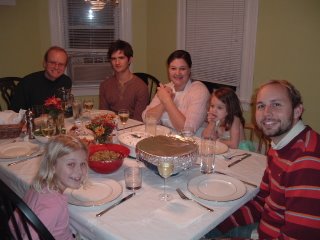
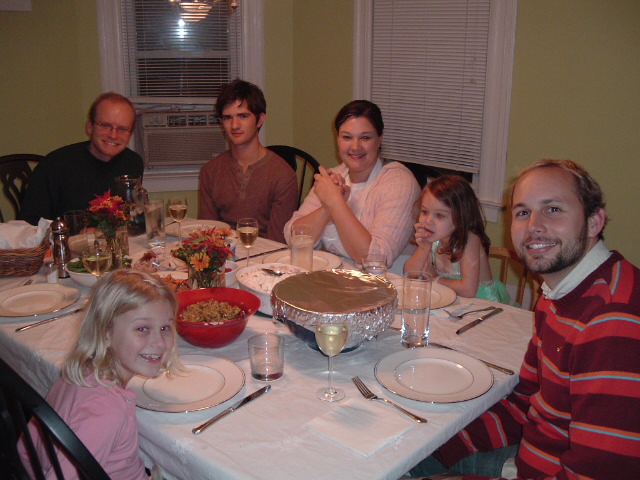
On Thanksgiving day, our table included Keri's cousin Joel, Jed's friend Ben (and now my friend too!), Keri, L, Jed, and E.
 Friday I had to work, but the girls joined me. We took the ferry across the Hudson to Lower Manhattan from the train station in Hoboken. It was a gorgeous day. L can never keep her finger out of her nose for pictures.

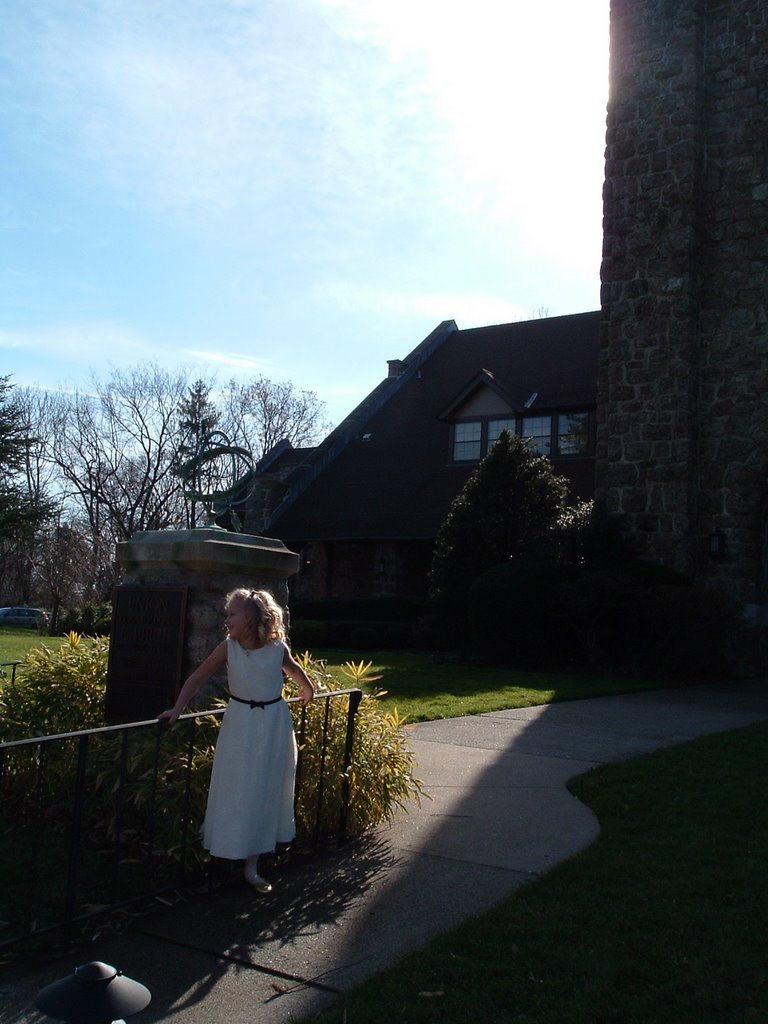
The weekend was capped with a birthday party and a baptismal service for E. On the almost eve of her eighth birthday, she was baptized at Union Congregational Church in Montclair, surrounded by family and friends.
On Thanksgiving day, our table included Keri's cousin Joel, Jed's friend Ben (and now my friend too!), Keri, L, Jed, and E.
 Friday I had to work, but the girls joined me. We took the ferry across the Hudson to Lower Manhattan from the train station in Hoboken. It was a gorgeous day. L can never keep her finger out of her nose for pictures.
The weekend was capped with a birthday party and a baptismal service for E. On the almost eve of her eighth birthday, she was baptized at Union Congregational Church in Montclair, surrounded by family and friends.
Friday, November 24, 2006
New Voice
you are making an impact--not by writing about what you think--but by writing about what you do, proving that your path can lead to a productive, happy, healthy live.
As I have comtemplated where to go with this blog, I keep coming back to this comment from santorio, left on my "Frustration" thread. I want to continue writing about my coming out experiences, and I'd like to extend my writing back to include earlier times in my life as well.
HURRICANE will now be a debate-free zone. I still welcome comments and discussion about the issues that emerge in discussion of my life experiences, but I won't be using this blog to debate about homosexuality. My position is as clear as it could be: I am not conflicted about the morality of homosexuality or homosexual relationships, and I reject the suggestion that homosexuality is inherently defective or that homosexual relationships are inherently sinful. We've had those discussions, and this will no longer be the place for them.
I am not, however, abandoning active debate about gay issues. At some point between now and the end of 2006, I intend to start a new blog that will focus on gay rights, activism, politics and the many and varied social issues that impact gay people. Stay tuned.
Wednesday, November 15, 2006
Frustration
I haven't had much to say lately. Well, actually, that's not true. I have a lot to say. But now that I have moved into a new phase of life, I'm having a hard time figuring out the right way and the right place to say it. This blog was originally a form of therapy for me. It was a place I could write about my coming out experience, my changing religious beliefs, my evolving family structure, the end of my marriage, and the beginning of a new relationship. But I'm out now, and my life has found a certain stability that it lacked when I started this blog.
So that's my first frustration. HURRICANE needs a new voice and I'm struggling to find it.
My second frustration is what I feel is the failure of my ongoing dialogue about gay Mormon issues with many Mormons, including the gay married Mormons that I share space with here in the gay Mormon bloggosphere. I'm certain that I bear some of the responsibility for that failure. I feel a great deal of frustration that so many who look at the world through the LDS prism see homosexuality and homosexual relationships as monolithic. Committed partnerships, truck stop trists on the New Jersey Turnpike, an honest divorce, a long-term secret love affair. From the LDS perspective, all seem to be the same because they are homosexual in nature. It seems obvious to me that they are not.
I'm generalizing my interactions here. In fact, I have made a lot of progress toward mutual respect and understanding with many of the LDS people who are most important to me in my life--family, including my dear former in-laws whom I still love like my own parents, and many longtime friends. It seems to be online where I encounter most of my frustration.
I'm aware of my own bias. I acknowledge that when I see men living through situations similar to my own I want to encourage them to follow a similar path, for their own sake and for the sake of their wives. I want to tell struggling young gay Mormons to accept their sexuality, embrace themselves and the blessing of being gay, and see what life outside the confines of Mormonism might offer them. I see the struggles of so many and think that so much of the pain and loneliness felt by those in and out of marriages could be alleviated if they could just accept that homosexuality is normal and homosexuals can live happy, healthy, well-adjusted lives as homosexuals.
John Galt suggested to me that I've forgotten what it's like to be Mormon. I suppose he's right. As odd as this is coming from a former LDS bishop, I can no longer understand why we are willing to endure so much pain for religious beliefs which utterly fail to explain human reality. This is not just a criticism of LDS Mormonism and homosexuality. I read in this morning's paper about the recent decision of Conference of Catholic Bishops in the U.S. to reiterate the church's prohibition on articifical contraception. I find myself scratching my head when I encounter moments when religious dogma is more important than the daily realities of people's lives. Too often it seems that tradition is exalted above actual people. That frustrates me.
I'm picking on religion here, but dogmas are found in many varieties. I know that some of my critics here in gay Mormondom think I'm dogmatic in my embrace of gay pride. I'm willing to admit that I might be at times. I try very hard not to be, but I know that I fail. I try to understand my own truth and recognize that it applies to me and no one else. But sometimes the evangelical zeal grabs hold.
The holidays are soon upon us. My children and KK (and the dog!) arrive tonight for a two week visit. I think it's time to stop convincing for awhile. We often try to convince others primarily as a way to convice ourselves. I don't want to do that anymore. I'm happy with where I am in life. I don't need to convince myself or anyone else of that. I think the best convincing I can do now will come through the example of a life lived fully and honestly.
Bear with me will I try to find a new voice.
So that's my first frustration. HURRICANE needs a new voice and I'm struggling to find it.
My second frustration is what I feel is the failure of my ongoing dialogue about gay Mormon issues with many Mormons, including the gay married Mormons that I share space with here in the gay Mormon bloggosphere. I'm certain that I bear some of the responsibility for that failure. I feel a great deal of frustration that so many who look at the world through the LDS prism see homosexuality and homosexual relationships as monolithic. Committed partnerships, truck stop trists on the New Jersey Turnpike, an honest divorce, a long-term secret love affair. From the LDS perspective, all seem to be the same because they are homosexual in nature. It seems obvious to me that they are not.
I'm generalizing my interactions here. In fact, I have made a lot of progress toward mutual respect and understanding with many of the LDS people who are most important to me in my life--family, including my dear former in-laws whom I still love like my own parents, and many longtime friends. It seems to be online where I encounter most of my frustration.
I'm aware of my own bias. I acknowledge that when I see men living through situations similar to my own I want to encourage them to follow a similar path, for their own sake and for the sake of their wives. I want to tell struggling young gay Mormons to accept their sexuality, embrace themselves and the blessing of being gay, and see what life outside the confines of Mormonism might offer them. I see the struggles of so many and think that so much of the pain and loneliness felt by those in and out of marriages could be alleviated if they could just accept that homosexuality is normal and homosexuals can live happy, healthy, well-adjusted lives as homosexuals.
John Galt suggested to me that I've forgotten what it's like to be Mormon. I suppose he's right. As odd as this is coming from a former LDS bishop, I can no longer understand why we are willing to endure so much pain for religious beliefs which utterly fail to explain human reality. This is not just a criticism of LDS Mormonism and homosexuality. I read in this morning's paper about the recent decision of Conference of Catholic Bishops in the U.S. to reiterate the church's prohibition on articifical contraception. I find myself scratching my head when I encounter moments when religious dogma is more important than the daily realities of people's lives. Too often it seems that tradition is exalted above actual people. That frustrates me.
I'm picking on religion here, but dogmas are found in many varieties. I know that some of my critics here in gay Mormondom think I'm dogmatic in my embrace of gay pride. I'm willing to admit that I might be at times. I try very hard not to be, but I know that I fail. I try to understand my own truth and recognize that it applies to me and no one else. But sometimes the evangelical zeal grabs hold.
The holidays are soon upon us. My children and KK (and the dog!) arrive tonight for a two week visit. I think it's time to stop convincing for awhile. We often try to convince others primarily as a way to convice ourselves. I don't want to do that anymore. I'm happy with where I am in life. I don't need to convince myself or anyone else of that. I think the best convincing I can do now will come through the example of a life lived fully and honestly.
Bear with me will I try to find a new voice.
Tuesday, November 07, 2006
Decision 2006
I voted today on a fancy new electronic voting machine. Here's hoping my vote actually gets counted.
I marked my ballot as follows:
U.S. Senate: ("Boss") Bob Menendez (D)
U.S. House, 8th District-NJ: Bill Pascrell (D)
Essex County Executive: Joseph D. Vincenzo (D)
Property Tax Reform: YES
Preserved Open Space Amendment to State Constitution: YES
Gasoline Tax Reallocation Amendment to State Constitution: YES
In many years, I might have considered voting for Sen. Menendez's Republican challenger, Tom Kean, Jr. But not this year with control of the Senate hanging in the balance.
I marked my ballot as follows:
U.S. Senate: ("Boss") Bob Menendez (D)
U.S. House, 8th District-NJ: Bill Pascrell (D)
Essex County Executive: Joseph D. Vincenzo (D)
Property Tax Reform: YES
Preserved Open Space Amendment to State Constitution: YES
Gasoline Tax Reallocation Amendment to State Constitution: YES
In many years, I might have considered voting for Sen. Menendez's Republican challenger, Tom Kean, Jr. But not this year with control of the Senate hanging in the balance.
Subscribe to:
Posts (Atom)